
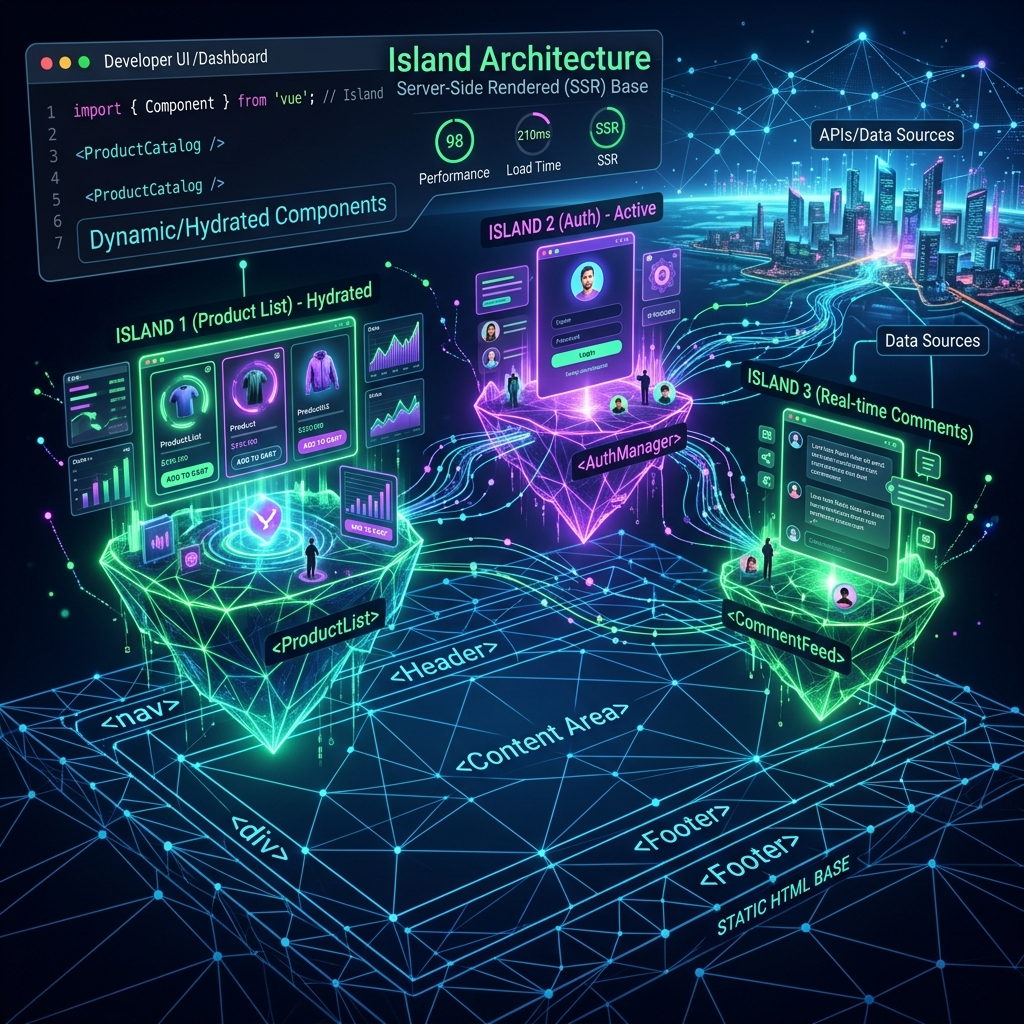
Web developers are waging war on bundle sizes. For years, single-page application (SPA) frameworks delivered excellent interactivity at the cost of massive JavaScript payloads. In 2026, the industry is shifting toward modular architectures, with Micro-Frontends and Island Architecture leading the charge for lightning-fast performance.
The Problem with Monolithic SPAs
Modern single-page applications are incredibly heavy. To render a simple interactive page, browsers must download, parse, and execute megabytes of JavaScript before users can interact with the content. This causes high First Input Delay (FID) and poor Interaction to Next Paint (INP) scores, especially on budget mobile devices. The solution isn't to write less interactive features, but to change how those features are delivered.
"By treating interactive components as isolated islands floating in a sea of static HTML, we can reduce JavaScript delivery by up to 80% while retaining full app interactivity." — Innogreets Frontend Engineering Team
What is Island Architecture?
Island Architecture is a design pattern that renders HTML pages on the server and injects small, isolated placeholders (islands) of dynamic interactivity only where needed. Instead of hydrating the entire page using a monolithic framework, the browser only hydrades the specific components that require client-side execution—such as an image carousel, a shopping cart badge, or a real-time chat box.
The Power of Micro-Frontends
Complementing Island Architecture is the Micro-Frontend model, which applies the principles of microservices to the frontend. Rather than building a large, single-codebase application, teams build independent, deployable modules that fit together seamlessly. A product catalog island might be built in React by team A, while the reviews widget is built in Svelte by team B. They all load on the same page with zero framework interference or runtime clashes.
Key Advantages of Islands & Micro-Frontends
- Unrivaled Page Speeds: Since most of the page is static HTML, load speeds are incredibly fast. Core Web Vitals improve immediately, directly boosting search engine rankings.
- Framework Agnostic: Build individual islands using the best tool for the job. Migrate components piece-by-piece rather than committing to costly full-site rewrites.
- Autonomous Development: Different teams can build, test, and deploy their frontend modules independently without coordination bottlenecks or deployment dependencies.
- Subtle Micro-Hydration: Load client-side JS only when the user scrolls the component into view or when the browser goes idle, using directives like
client:visibleorclient:idle.
Conclusion
The transition to Island Architecture and Micro-Frontends is reshaping enterprise web applications in 2026. By decoupling logic and restricting JavaScript hydration to where it actually counts, organizations can deliver premium, dynamic user experiences that load instantly. At Innogreets, we design and build with modular performance frameworks like Astro and module federation, engineering high-scale frontends designed for speed, flexibility, and longevity.