
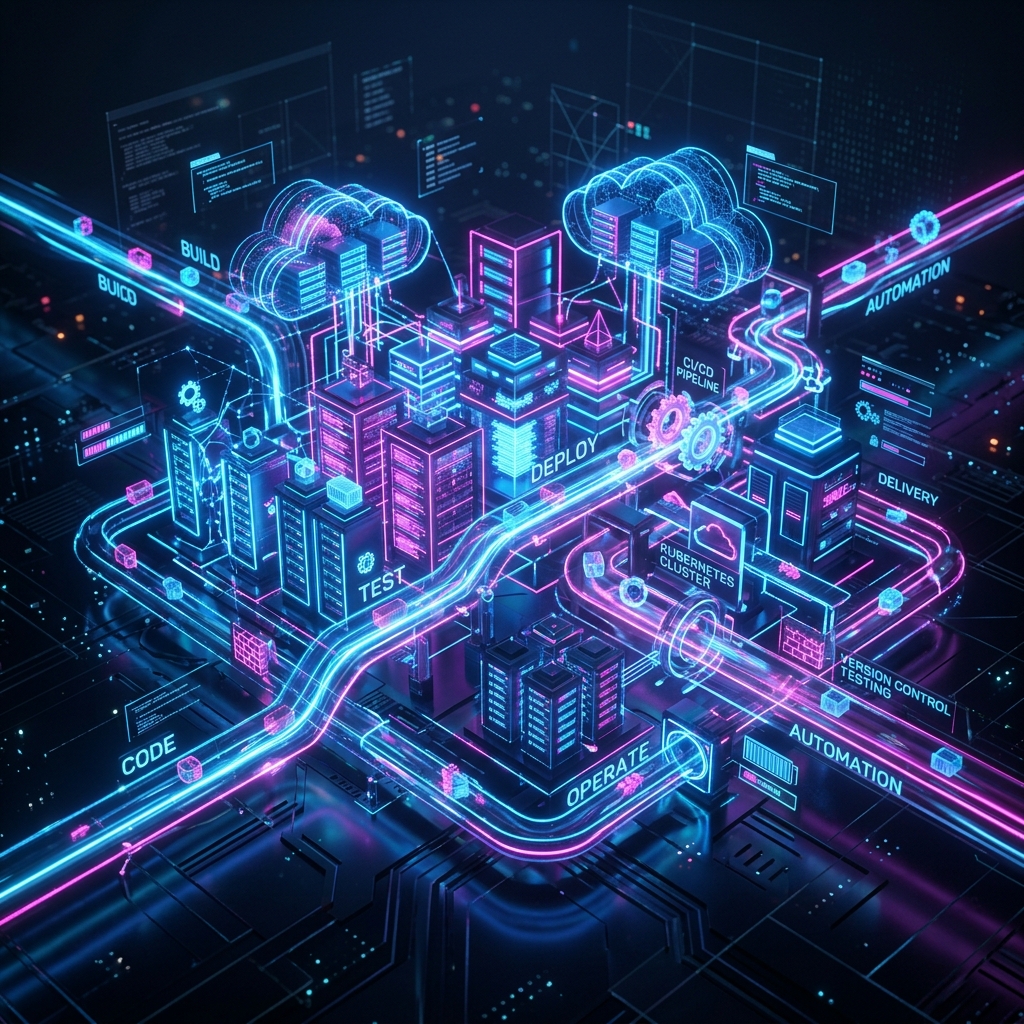
As AI writes more boilerplate code than any human team could produce, the role of software developers in 2026 is undergoing a fundamental transformation. The most valuable engineers today are not those who type the fastest — they are those who can think the deepest about architecture, security, and the governance of AI systems operating at scale.
The Boilerplate Automation Era
In 2026, AI coding assistants handle the majority of routine implementation work. CRUD operations, API integrations, UI scaffolding, unit tests, and documentation are now largely generated automatically from high-level specifications. This is not a threat to developers — it is a liberation. The cognitive overhead that once consumed 60% of engineering time has been dramatically reduced, freeing engineers to operate at a higher level of abstraction.
"AI is automating the easy parts of software development so humans can focus on the hard parts — the parts that actually require genuine intelligence." — Senior Engineering Lead, 2026
The New Core Competencies
The most in-demand developer skills in 2026 have shifted decisively:
- System architecture: Designing resilient, scalable, maintainable systems that can evolve over years — this requires deep judgment that AI models cannot replicate reliably.
- Security auditing: With AI generating more code, the attack surface grows. Engineers who can systematically identify vulnerabilities, reason about threat models, and design defense-in-depth systems are extremely valuable.
- AI pipeline governance: Managing multi-agent systems requires understanding how to define guardrails, detect failures, handle hallucinations gracefully, and maintain audit trails of AI-driven decisions.
- Prompt engineering and AI UX: Crafting effective interactions between human intent and AI execution has become a sophisticated engineering discipline.
- Data architecture: AI systems are only as good as the data they work with. Designing clean, well-governed data pipelines is foundational to everything else.
Security as a First-Class Concern
The security landscape in 2026 is more complex than ever. AI-generated code introduces subtle vulnerabilities that traditional static analysis tools were not designed to detect. Prompt injection attacks, model poisoning, and data exfiltration through AI pipelines represent entirely new attack vectors that security teams are racing to understand and defend against.
Developers with deep security knowledge are among the most sought-after professionals in the industry. Organizations that treat security as a bolt-on afterthought are discovering — often painfully — why it needs to be engineered in from the beginning.
Governance of Multi-Agent Systems
As organizations deploy AI agents that can autonomously take actions — sending emails, making API calls, modifying databases, executing code — the need for robust governance frameworks becomes critical. The best engineering teams in 2026 have developed systematic approaches to:
- Defining clear capability boundaries for each AI agent in a pipeline
- Implementing human-in-the-loop checkpoints for high-stakes decisions
- Maintaining comprehensive audit logs of every AI-driven action
- Testing agent behavior under adversarial conditions before deployment
- Designing graceful fallback paths when AI systems fail or produce unexpected outputs
Career Paths for the 2026 Developer
The developer career landscape has bifurcated. Engineers who lean into AI collaboration, treating it as a superpower that amplifies their capabilities, are experiencing unprecedented productivity and career growth. Those who resist the shift — insisting that hand-writing boilerplate is the mark of a "real" developer — are finding themselves increasingly marginalized.
The winning mindset is one of continuous adaptation: embracing AI assistance for routine work while doubling down on the uniquely human skills of judgment, creativity, ethical reasoning, and systems thinking that no language model can fully replicate.
Conclusion
The 2026 developer is less a coder and more an architect of intelligent systems — someone who understands not just how to build software, but how to govern AI systems that build software on their behalf. This is a more demanding role in many ways, requiring broader knowledge and deeper judgment. But it is also a more interesting, more impactful, and more rewarding one. The developers who embrace this shift are building the future.